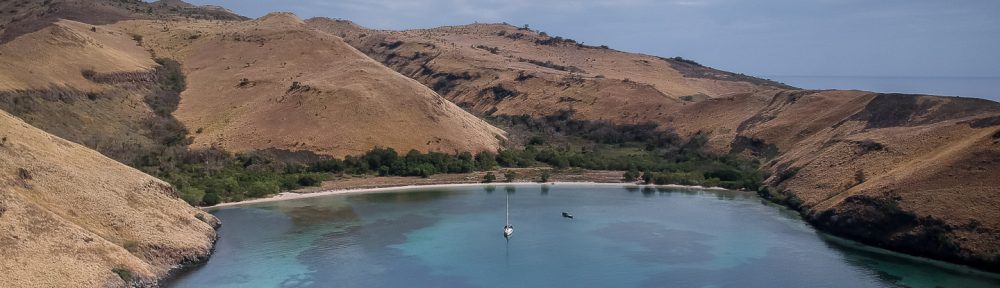
The Percy Isles

The guide books (Alan Lucas) recommend the Percy Isles as a stopover on the passage to the Whitsundays and I reckoned it was sensible to go with Alan’s recommendations for my first passage up the coast. The Percy Isles certainly exceeded all our expectations!

We arrived at South Percy Island at midnight after a long day of trade wind sailing under spinnaker we eased into our anchorage for a peaceful night.

Trade wind sailing under spinnaker

The following morning, in deference to the late night, I enjoyed a quiet morning on deck with coffee and my “Ouma” rusks while the crew slept peacefully. At about 9AM we set sail for Middle Percy Island and anchored West Bay for the day.

Sunny Spells anchored at Middle Percy Island

We spent a delightful day at Middle Percy. After cleaning the boat (great crew!) Sarah swam out to the beach while George and Vicky paddled out. They spent a lovely morning exploring the island and the shed on the beach (the “Hilton”!)that has the greatest collection of artifacts left by yachties over the years.

I, meanwhile, set about doing some essential repairs.

First on the list was the alternator… While it was still charging, more or less, it wouldn’t get over 12.6 Volts, and I suspected the engine electrical panel and alternator warning light/field circuit. When that checked out okay, I stuck my head into the engine room where the fault was immediately obvious: the earth wire to the alternator had broken off! This was easily fixed by crimping a new lug on the wire and. voila she was charging at 14 volts or better again!

My second task was to re-splice the anchor chain to rope connection. This had started to fray after a couple of trips through the windlass gypsy. Now it got jammed in the windlass every time and I was also worried about the strength of the splice. I soon had that spliced and was well chuffed with the appreciative comments from the crew!

The Hilton on Middle Percy

Later that night, after a lovely beach barbeque, the crew took a (surplus to reqs) danbuoy back to the shed suitably inscribed it and left our token.

Our addition to the Middle Percy shed of memories

The crew decided that preparing food on dry land was a good idea and a barbeque was soon planned. While we swam and fished Sarah put everything together. George and Vicky were on the beach already, collecting firewood, and Sarah ferried me to the beach at sunset.

The luxury of being ferried to the beach!

Having a barbeque on the beach was a lovely change of pace. We were treated to a stunning sunset, the food was great and the three trips back to the boat in the dinghy felt like just the right way to end the evening.

Sunset at Middle Percy Island

The Romantic Navigator

The romantic in me insists that sailing belongs to a time when real men with long grey beards squinted through brass sextants to fix their vessels’ positions with pin-point accuracy, predicting landfall to the nearest hour… That hasn’t stopped me from kitting Sunny Spells out with the latest GPS chartplotter; in fact, at last count I carry four GPS receivers on board if I include my Nokia Navigator mobile phone. Hopefully the handheld, floating Garmin GPS and spare batteries travelling in a tin in the grab bag will survive a lightning strike…

Before our first passage I purchased an updated set of paper charts of the Australian East Coast, just to be sure, and a Davis Mk III sextant came my way at Birthday time, so now I had the tools, if not the skills.

So, how to acquire the skills?

The sextant came with pretty good instructions: it comprises about 10 pages, notebook size, with enough information and the basic tables to enable you to calculate a fix from a noon sighting of the sun. This was a revelation to me, as one of the things that always made me shy away from doing the sextant thing (sounds suggestive, eh?) was the perceived need to carry volumes of tables and almanacs to do the calculations, and update these every year.

While on passage between North Keppel Island and the Percy Isles in July 2008 we floated downwind under spinnaker for hours on a calm sea: ideal conditions for learning the intricacies of the sextant.

Lesson 1: adjusting the sextant was a doddle, maybe because my instrument is so simple. It was quite a thrill though, finally holding the sextant in my hand and getting a feel for how it works.

Our next opportunity for continuing the education was two days later while continuing north from Middle Percy Island to Scawfell Island. In about four paragraphs of instructions and one small table I had enough information to do a noon sighting of the sun and plot our position to within 10 nautical miles! I was well pleased knowing I can now, in an emergency fix our position once a day and know that, with very limited data and an accurate timepiece, I can be within about 10 miles.

With my new found knowledge I could also show the crew how to take the sights and we all took turns to take sights every three minutes from about 11AM onwards – great practice.

Vicky taking a noon shot of the sun while George takes the time and logs the readings

Up the mast at sea

I’ve always wondered how difficult it is to go up the mast while at sea. We’ve had to now do it twice in the last four days, which must be unusual!

Up the mast while in a sea way

Soon after leaving Mooloolaba, as the light began to fade, the Genoa suddenly started flogging and then slipped down onto the deck and partly into the water! Once we had the sail lashed to the lifelines we realised that the top shackle had come undone and the halyard and top-swivel was still at the masthead. Sarah Belcher, first-mate for this leg, offered to go aloft, despite being hungover – they obviously breed them tough in NZ… We set the mainsail and ran off to keep the boat as upright as possible. George and I winched her up, she attached a thin line to the halyard and was soon back on deck. The yalyard was pulled down, sail was shackled (and the pin tightened properly) and soon we had all the canvas up again. This was all in open water, with about a 2 metre swell running. Sarah says it was quite “snappy” up there: not a rolling movement, but rather a sense of the mast trying to “flick one off”!

Yesterday we noticed that the main halyard had badly chafed about 12 inches from the shackle and I was worried that something had gone wrong with the masthead sheave, so up I went this morning. Now we were gently drifting up the Curtiss Channel in what is really closed water. It was rather pleasant. A bit more rolly than when at anchor, but no worse than when the Scotland Island Ferry wake rolls the boat around! Found nothing wrong at the masthead but got some pretty amazing photos!

Up the mast at sea, whacky perspective! Crew relaxing...