Mooloolaba to Lady Musgrave Island

Sunny Spells and my crew were waiting at Mooloolaba when I arrived. The crew are a nice bunch of people, keen sailors and everyone got along right from the start. The repaired mainsail was in the cockpit (thanks Ullman Sails!) and by 1630 we had left the Mooloolah River and had made sail in a 15 to 20 knot south-easter.

As the light began to fade, the Genoa suddenly started flogging and then slipped down onto the deck and partly into the water! Once we had the sail lashed to the lifelines we realised that the top shackle had come undone and the halyard and top-swivel was still at the masthead. Sarah Belcher, first-mate for this leg, offered to go aloft. We set the mainsail and ran off to keep the boat as upright as possible. George and I winched her up, she attached a thin line to the halyard and was soon back on deck. The yalyard was pulled down, sail was shackled (and the pin tightened properly) and soon we had all the canvas up again.

A long night of broad reaching saw us abeam Sandy Cape early the next morning, and by that afternoon we had done 145nm for the first 24 hours!

Beam reaching with the asymetric spinnaker into the Curtis Channel

The second night was tough…

The wind died, so we motored. It rained, and the squalls were gusty, so we pulled out the genoa, only to find the wind dying to nothing again within minutes.

We were all pretty tired by the time the sun came up. Sarah and I were sitting at the helm and, realizing that Lady Musgrave Island was only two hours motoring away, made an executive decision to divert for a bit of a rest and a night at anchor. As soon as we turned towards our new destination, we were close-hauled, and now there was enough apparent wind to kill the motor – just bliss! Sunny Spells loves sailing to windward and there was just enough wind for a very comfortable sail. Being behind the Reef there was also very little swell.

Close hauled headed for Lady Musgrave Island

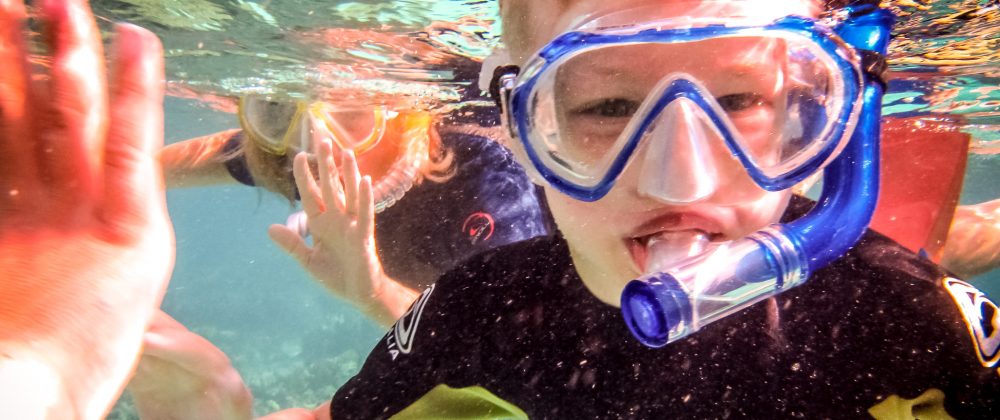
The anchorage at Lady Musgrave Island was sublime. We anchored in 7 meters of briliant turquoise water and, after a brilliant tidy-up by the crew (even the decks got a scrub!!) we were soon chilling out. The snorkelling was great (a bit scary to go down and see your own anchor…) and George inflated the dinghy so they could paddle to the island and explore.

George and Victoria paddling around the Lady Musgrave Island lagoon.

Latest weather…

Latest weather…

Our departure from Mooloolaba for Hamilton Island is drawing closer, and the weather forecast for the first leg around Fraser Island is beginning to crystalize. It looks pretty benign, if not a tad boring!

Grib weather for 26 June to 3 July 2008

Making headway against the Australian East Coast Current might be a bit of a challenge though…

Oh well…

At least it is meant to breeze up towards the end of the week, and we should have pretty good trade winds for the rest of the passage!

Ocean surface temperatures and currents for 26 June 2008, courtesy CSIRO Remote Sensing.

Freedom from the “Tyrrany of the Tiller”

I have an ST4000+ wheelpilot on my 33ft Dick Carter sail boat. IMHO it is an essential piece of safety equipment when you are sailing shorthanded, or even just with a smaller crew (i.e. less than 4 people).

I recently had a challenging night offshore after splitting the mainsail in a squall (just after putting the 3rd reef in). Even though I had two crew, they were both too sea-sick to be of much use, and the autopilot steered perfectly under motor while I lashed the main to the boom and set the storm tri-sail.

The benefits in freeing you from the “Tyrrany of the Tiller” is obvious.

It is vitally important though that you:

  • fit a rudder angle sensor, otherwise the Autohelm performance will be mediocre at best, but probably next to useless;

  • select the location for the fluxgate compass very carefully to avoid magnetic and RF interference.

  • Getting it as close as posible to the keel will also minimise unecessary movement of the fluxgate, making the Autohelm more stable;
  • make sure all wiring is done professionally, cable joins are avoided as far as possible and cables are routed in dry areas (keep them out of the bilge if possible).

The Autohelm on Sunny Spells was pretty useless when I bought her, but after fixing the problems listed above, she now helms perfectly downwind for hours on end. I’ve had an 11 hour run downwind with poled out genoa and main by the lee without touching the autopilot controls (on wind-vane mode) other than accepting wind shift alarms.

The best $1000 you can spend!

Navbus/NMEA and Displaying Wind Data

Mystery solved…

After a lot of correspondence, telephone calls and hours in the boat, in front of the laptop, decoding NMEA0183 sentences (did I really need to know all this stuff??), the mystery is finally solved…

It appears that the chartplotter firmware is the culprit. If Navbus is enabled on the chartplotter, it will only accept wind data from Navbus, not the NMEA0183 input. Disable Navbus, and the wind data is displayed!

It seems like a quick fix, but it comes at a price. The biggest issue is that DSC capability (i.e. automatic communication with the VHF to receive and transmit DSC messages) is lost. Also, the barometric pressure and air temperature data sensed by the VHF is now not available at the helm… Navman’s John Dusting said that he would request a firmware update to solve this issue, but it could be a while…