Bora Bora to Vava’u

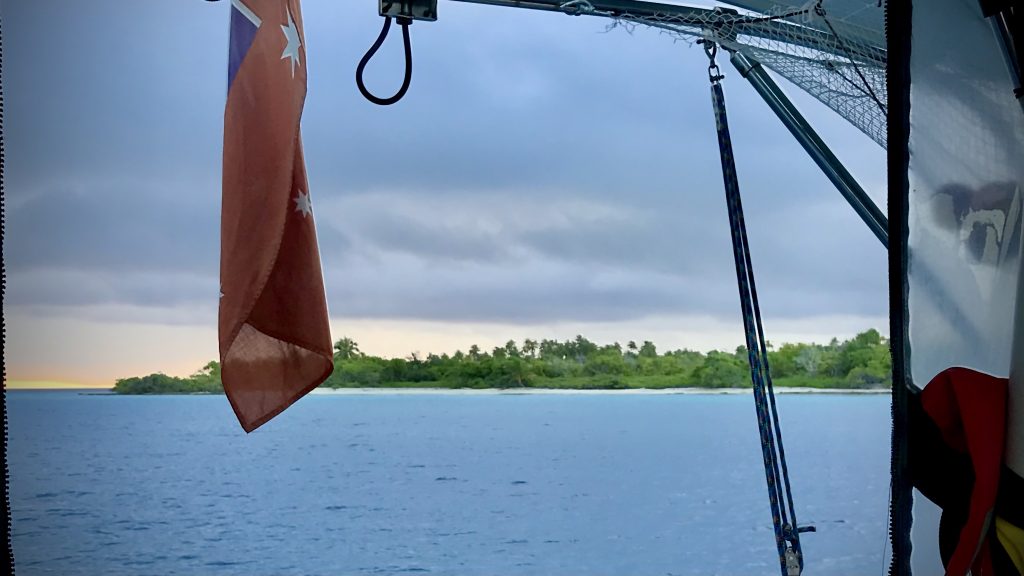
We left Bora Bora at sunrise on Sunday, headed Vava’u in Tonga. We are routing north of Maupihaa atoll first, in case the forecast turns nasty for the Cook Islands /Tonga. That way we can head for Samoa instead. The wind was initially light, but filled in to around 15-18 knots so we were making good miles. With a swell below 2m and evenly spaced it was very pleasant.

We are dealing with faults on both our DC-DC chargers, so we have to manage power closely. Fortunately, it was quite sunny, and our solar panels managed to get the batteries back to 100% every day.

The wind died just before 10AM Tuesday, marking the arrival of the rain front associated with a low-pressure system hundreds of miles south of our position. The 9AM weather update also showed potential nasty weather moving in over the Tonga area within 24 hours of our predicted arrival time. Bobbing and rolling at 2 knots in barely a breath of wind was not an option, so the motor was started, and we were soon chugging along at around 5 knots towards our destination.

In the afternoon we bagged the staysail and stowed both poles, as downwind sailing is not in our future for the next few days. We motored for almost last 20 hours but, on the upside, the remaining functional but erratic DC-DC charger kept pumping out a steady if disappointing 30 Amps (from our 115 Amp alternator).

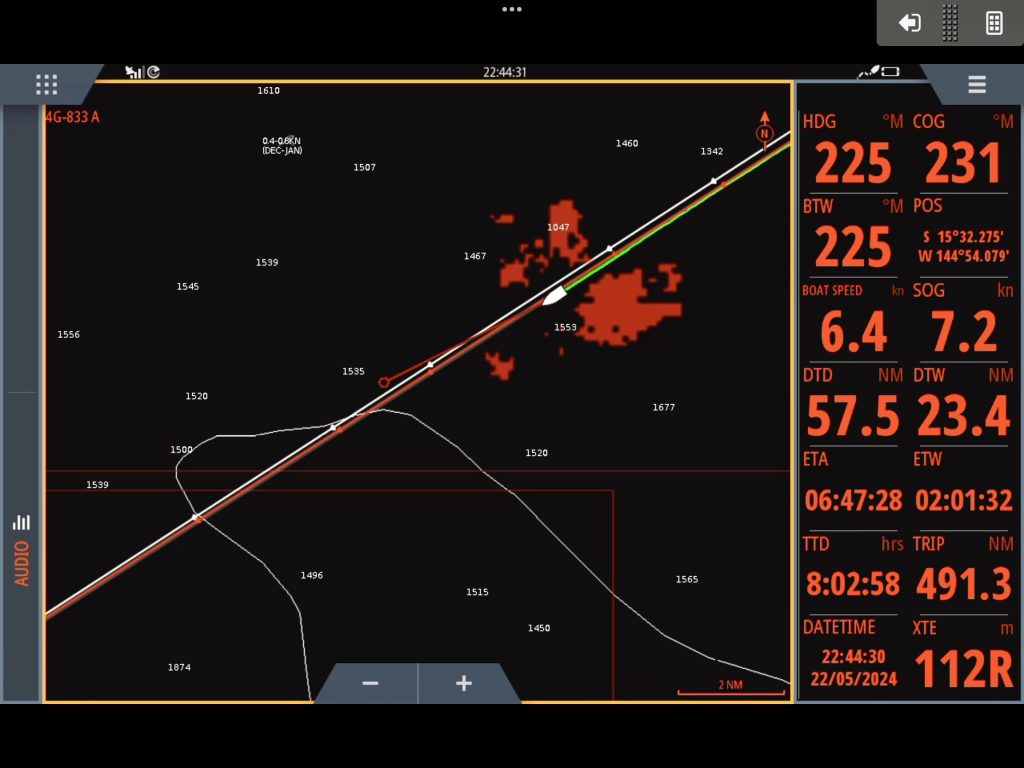
The forecast rain started in the late afternoon on Wednesday (why always just as it is about to get dark??) and became torrential with gusty headwinds to 25 knots around 10:30PM. The captain was summoned and, after surveying the scene for an hour, declared that there was nothing to be done, leaving the first mate, by now in life jacket, to keep the ship steady. The rain came and went all night, accompanied by gusty southerly wind. Some diffuse lightning was also visible to the north, but the radar showed nothing except a large cell more than 36 miles to the north.

At daybreak on Thursday the rain eased, and the wind abated to around 5 knots (of course, it was now daylight), revealing a pretty flat sea. “It won’t stay like this”, we said, and sure enough, things started going downhill shortly after. The forecast was for SSE winds at 12 knots, steadily increasing to 16 knots through the day. The reality on the water was a rapid increase to around 20 knots, gusting 25 of winds from the SSW, i.e. forward of the beam. The sea state also rapidly deteriorated into the “washing machine” state. In addition, we the difference between our heading and actual course was 10 to 15 degrees, and it appeared we were making a lot of leeway, requiring a further turn into the wind. We were soon crashing into and over waves with only the triple reefed main and half the small headsail. The winds were gusty too, with even the small sail plan groaning and propelling us to over 8 knots during the gusts.

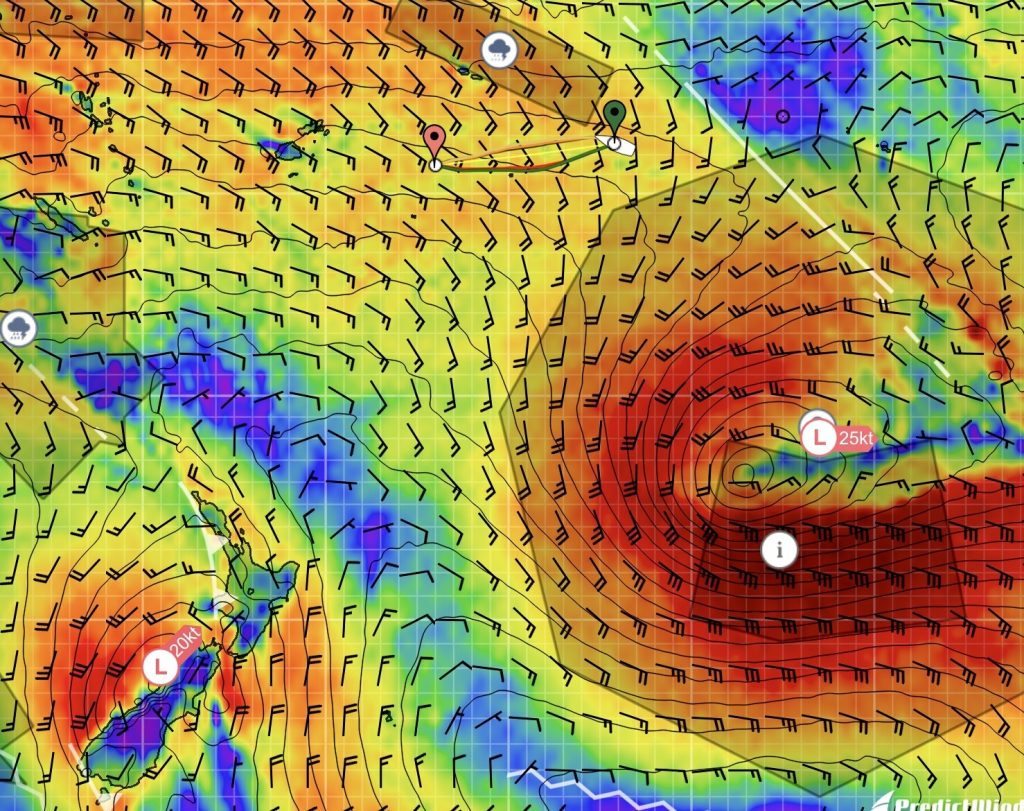
In last night’s update a deep and extensive low-pressure system south of us had materialised, with the forecast high being squashed to a small ridge. Dave, the skipper on Warrior, who is 100 miles south/ahead of us, sent us an update from his onshore weather router pointing out that the low is visible on the satellite imagery and would torment us for a while longer but that the impacts would abate over the next 24 hours.

It was difficult to keep any sort of pace up in these conditions as Sunny Spells would just launch herself off the top of each wave and crash back into the water with every passing swell. We had to slow down and turn downwind a bit to preserve boat and sanity.

Conditions very slowly improved through the night, mostly as the waves became more regular and our wind angle improved ever so slightly. It is now Friday morning, and the wind is still gusting 26 knots on the beam, so we are not out of the woods just yet.
Fakarava to Tahiti

We were up at 5AM to exit via the south pass at sunrise and, theoretically, just after slack (high) water. At the shallowest part of the pass the ebb current was already running three to four knots. The overfalls were not too bad, but outside the pass the wind and swell meeting the out flowing water made for a nasty washing machine!

The sea state was lumpy all day yesterday – short and steep 2m waves less than 5 seconds apart. Not at all what the forecast promised. At least the wind was fair, 15 to 20 knots from behind, and we have averaged better than 7 knots all day, making a daylight landfall in Tahiti potentially doable.

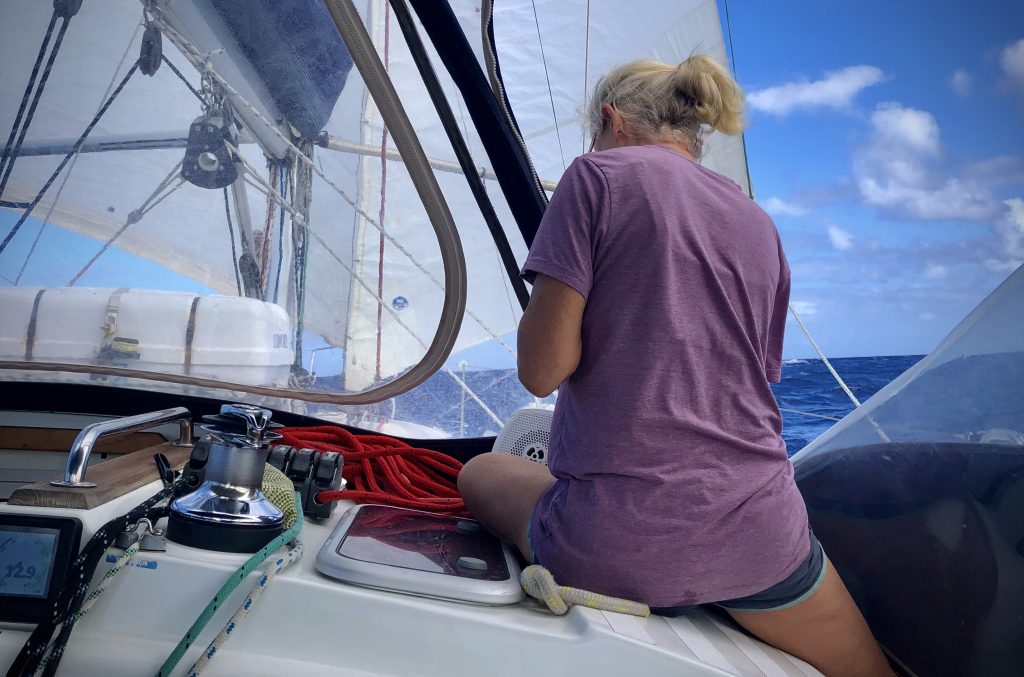
Our clear plastic cockpit enclosure is beginning to show its age. One of the issues is that the white thread used by the sailmaker to sow all the white zips to the canvas is not UV proof and is now simply disintegrating. A section of about half a meter let go today, but fortunately Maria is a dab hand with the hand stitcher!

A few cloud fronts passed over in the night, but mostly countered the trade wind, resulting in less wind rather than more.

Around the middle of the day the wind just up and died, just after a light rain shower. Once our speed dropped below 2.5 knots I couldn’t stand it any longer, so the engine was started and we motored the last 5 hours to Tahiti. A bit of a disappointment as it was looking good for getting here in daylight under sail. We doused the two foresails and stowed the two poles and then rolled out the genoa on the starboard side to get a little push from the very light wind (about 5 knots) on our beam. Thus we motor-sailed until we got a mile or so away from the anchorage.

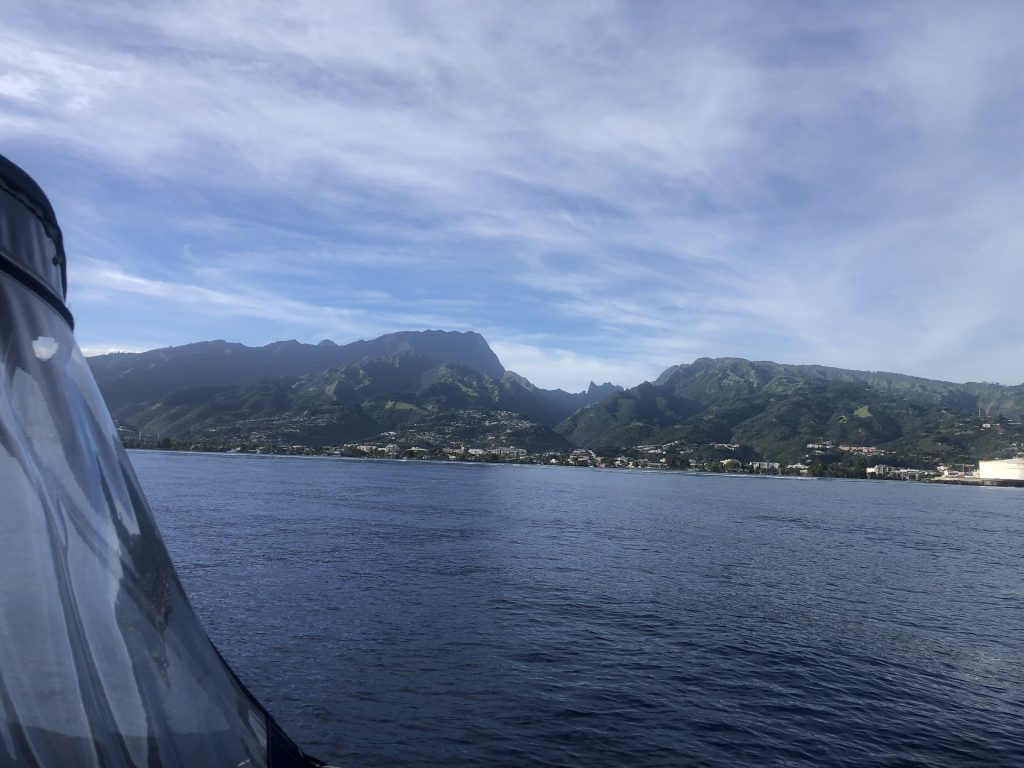
The night entry into the anchorage was not particularly difficult, but we had to pay attention as there were three boats here already. We let go the anchor in 9 metres and put out 50 metres of chain. The bottom here, behind Pointe Venus is apparently black sand from the volcanic formations, with good holding. Our anchor set solidly straightaway, and the anchorage was surprisingly calm and surge free, making for a good night’s sleep.

Sailing to the Tuamotus

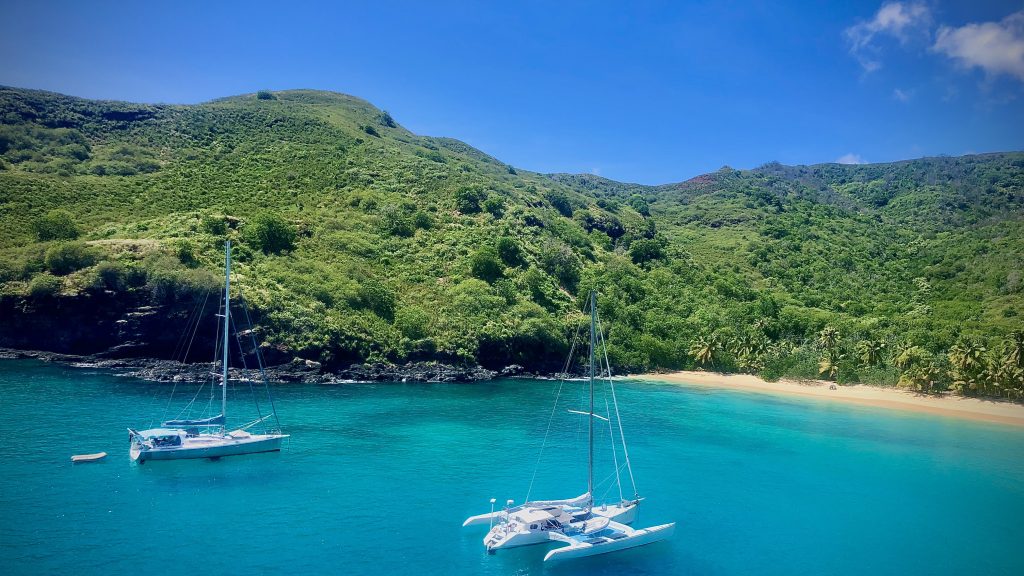
We spent a very pleasant four days here at Hanamoenoa Bay on Tahuata Island, only two hours mototoring from Atuona, Hiva Oa. Our main objective, scrubbing Sunny Spells’ bottom, was achieved in the first two days. It was not as bad as I had feared, but she still has a big bottom to scrub! The diarrhoea-yellow algae above the waterline I had rubbed off while we were still in the harbour at Atuona.

The snorkeling here was a little disappointing. Visibility was about 10m over sand, and the reefs are very degraded. There is virtually no coral in the bay. I headed out towards the northern headland where there is said to be a few manta rays, but stopped short as there was a bit of a current running out to sea and I did not have the dinghy with me.

I went up the mast to check out the rigging and lubricate all the stainless fittings with a thin film of WD40. Fortunately, everything checked out fine. I was treated to this drone-like view from the top of our 18m mast.

The plan for our next leg to Fakarava was to do a little detour south of the rhumb line to give us a better wind angle the last day or so when the winds are forecast to be a bit stronger.

The passage started with motoring as there was zero wind. I nearly turned back to Tahuata as the prospect of 3 days motoring, as forecast by two of the models, appeared to have materialised. Fortunately, the wind soon picked up and we were reaching with just the large #2 genoa for a few hours before setting the two poles as the wind started going aft of the beam.

The bottom scrub has paid dividends, as Sunny Spells is quick to accelerate in the light breeze. The sea state was generally very pleasant, with a long period ground swell of about 1.5m from the south on our starboard bow and very little by way of wind wave on top.

The weather on this passage turned out to be flaky, with both wind speed and direction changing a lot and quickly. We are in a transition zone between the southern winter weather nasties and the equatorial trade winds. There’s also a weak trough in this area, so lots of little cumulus that upset the wind direction and speed and threaten to rain. Here, we are between two squalls with 25 knots of wind on a broad reach, making 6 to 7 knots, only have 58 miles to go to the north pass at Fakarava Atoll.

We arrived at the north pass into Fakarava Atoll around 9:30AM, and just motored straight in without any current, turbulence or other nasties. We proceeded to the town anchorage at Rotoava village and briefly went ashore (after inflating the Zodiac) to pay the tourist tax.

Around midday we started motoring south inside the atoll and anchored at Kaukuraroa for the night, about halfway to the south pass anchorage. I’m hoping to arrange a drift dive through the south pass for Saturday, so that’s where we’ll be heading tomorrow.

We are the only boat here in the anchorage and we cannot see any other boats out in the atoll or buildings/people on land. Quite surreal after the crush of boats everywhere in the Med, Caribbean and even Hiva Oa. We sat on the back watching the sun set in the west, with a couple of manta rays surfacing over the reefs about 250m away. The real deal…

Landfall in the Marquesas

It’s done. The anchor is down in Atuona Bay, Hiva Oa, and Sunny Spells is at rest after 3,100 nautical miles of Pacific blue. I’m writing this from the cockpit, a bit weary, but full of that landfall glow — the deep kind, the earned kind.

The last few days, from the 5th to the 9th, reminded us that the ocean always has a final test. After more than a week of almost dreamlike sailing in the trades, we had to start making our turn to port to line up for Hiva Oa — and that meant putting the wind and sea more on the beam. Not uncomfortable exactly, but a bit more lively than we’d gotten used to.

The swells picked up a little — long, lumpy, and off-angle — which meant a lot more motion and the kind of interrupted sleep that makes you feel like you’ve been sailing for weeks (which, of course, we had). But the boat just kept trucking. Even with the shifting seas and slightly fresher breeze, Sunny Spells held 6 to 7 knots like it was nothing.

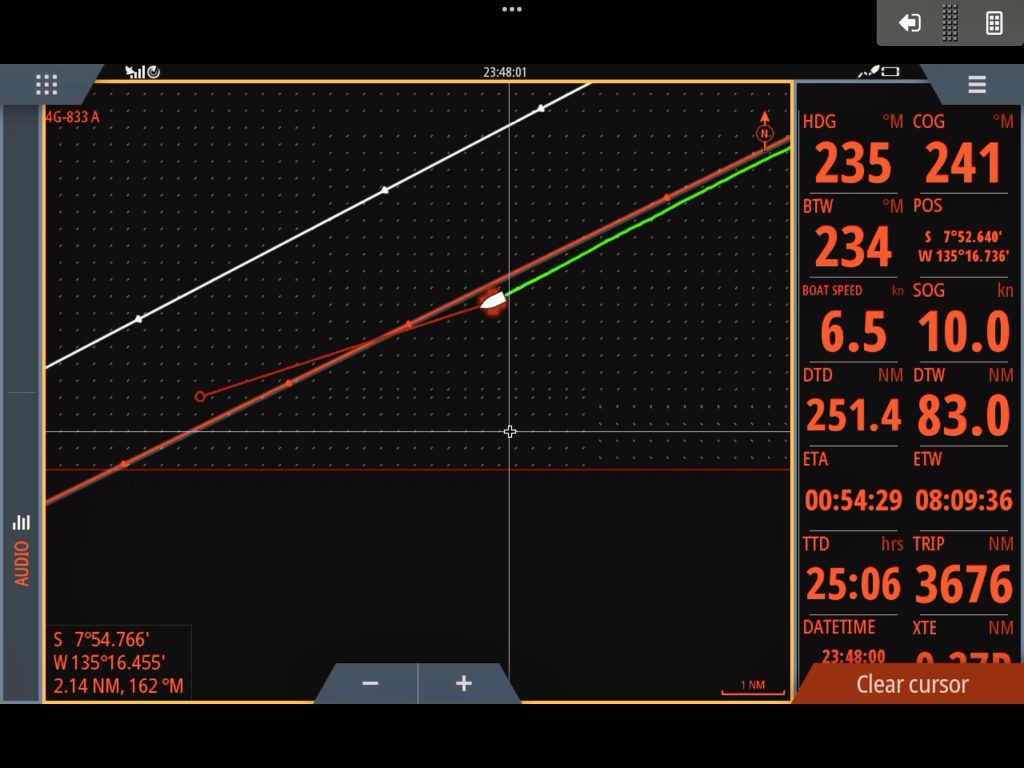
Screenshot as we hit 10 knots SOG on a nice long surf. We are not having trouble keeping the pace up at the moment!

By the morning of the 8th we could feel it — that almost physical sense of arrival. The air smelled different. The breeze felt warmer. There were birds again, real ones, not ocean wanderers but locals. One tiny land bird even flew aboard for a quick inspection before flitting off toward nowhere. We knew land was close.

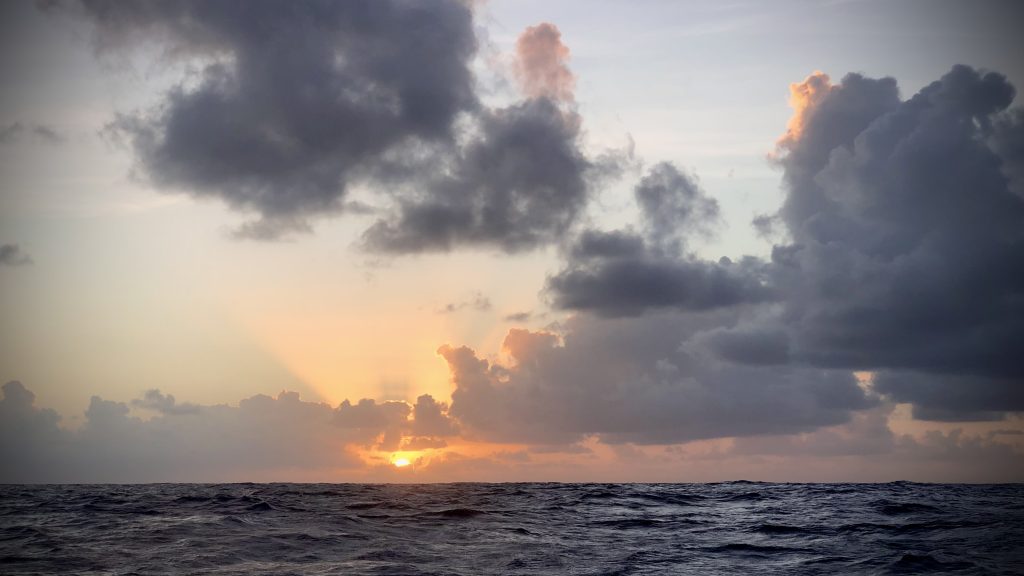
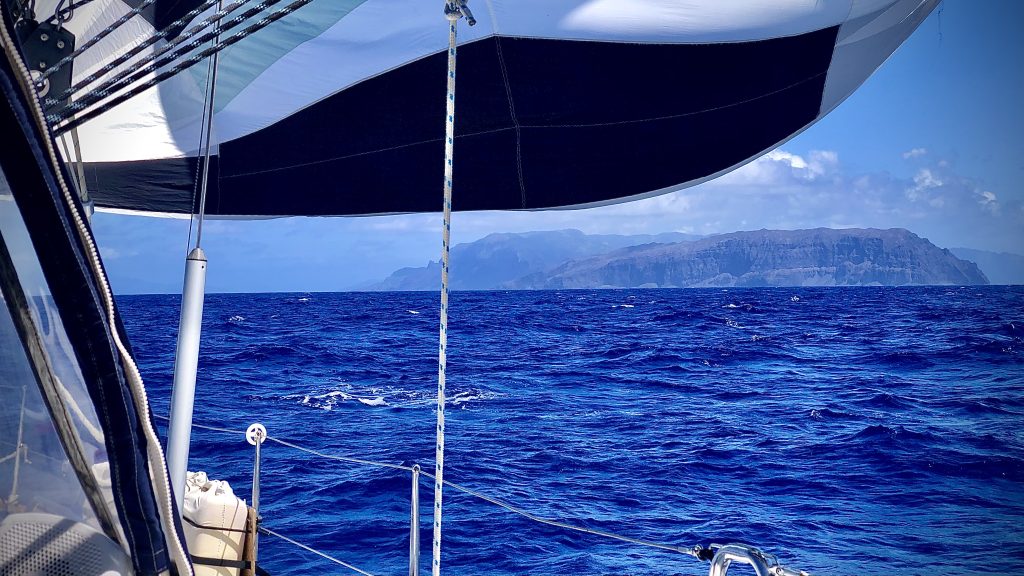
Then, just before first light on the 9th, there it was: a jagged silhouette on the horizon. Hiva Oa. Real land. We were still 20 miles out, but it was as if the crossing had ended the moment we saw it. Everything after that was ritual — sail trim, coffee, unlashing the anchor, switching off the ocean mindset and thinking about land and shoal water.

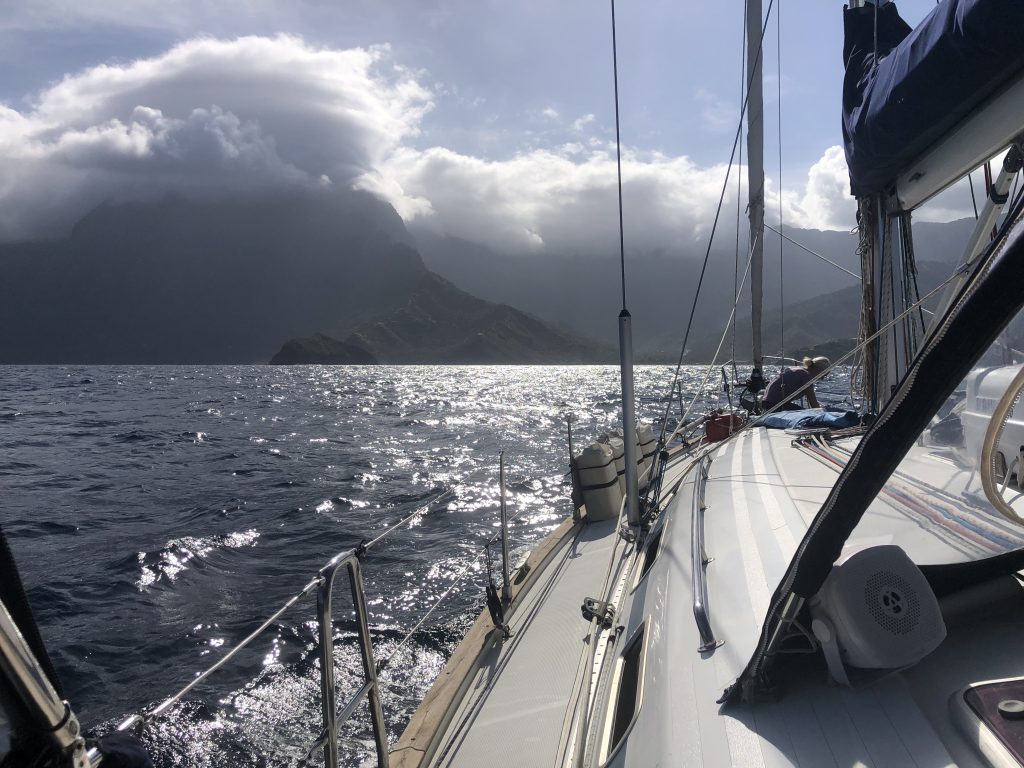
We rounded into Atuona Bay around 10AM. Mountains rising behind the anchorage, lush and sharp-edged, like something drawn from memory. The shoreline was dark volcanic rock, fringed with surf. A few other yachts gently swinging at anchor, and the smell — damp greenery, woodsmoke, soil. It’s always the smell that hits first.

We dropped anchor in about 9 metres, engine off, boat still. Just like that, the Pacific crossing was over.

There’ll be more to come — check-in, laundry, fruit, a baguette if we’re lucky — but for now we are just soaking up the stillness.

Sunny Spells carried us well. And now she rests.