Of Goosenecks and Galápagos Dreams

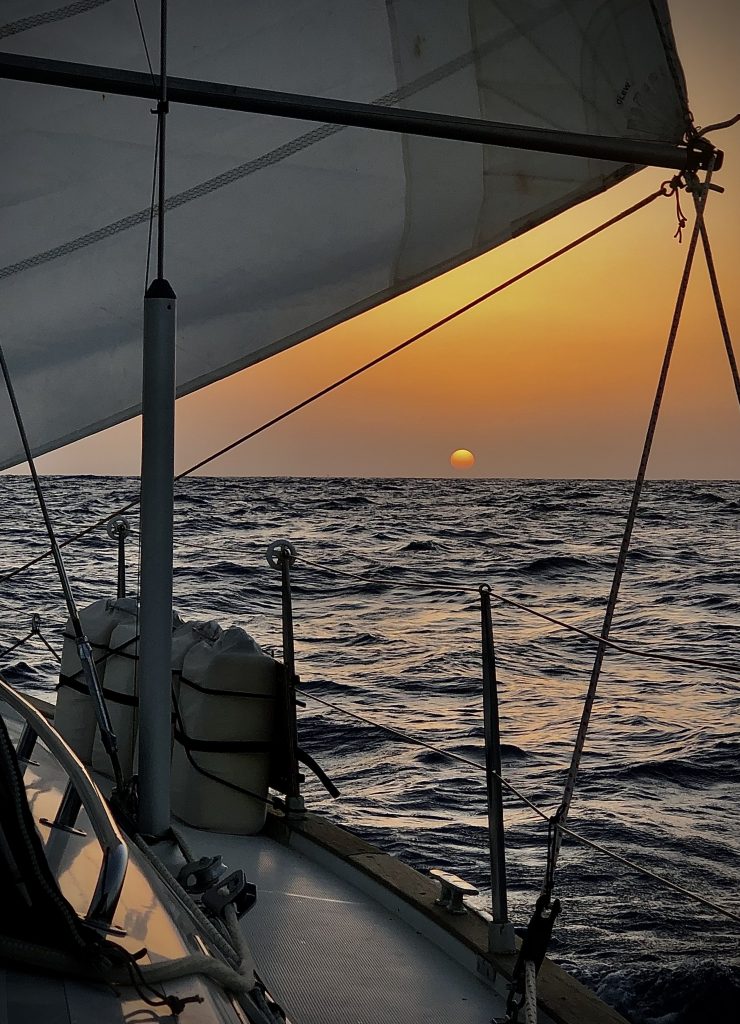
As we were enjoying the sunset this evening, we heard a loud cracking noise from the direction of the mast. On closer inspection it transpired that the 12mm stainless steel pin that holds the gooseneck together had sheared clean off. A disturbing breakage for sure. After rolling the genoa away we brought Sunny Spells head-to-wind and dropped the main. By this time part of the pin had fallen out and the boom was about to fall on the deck!
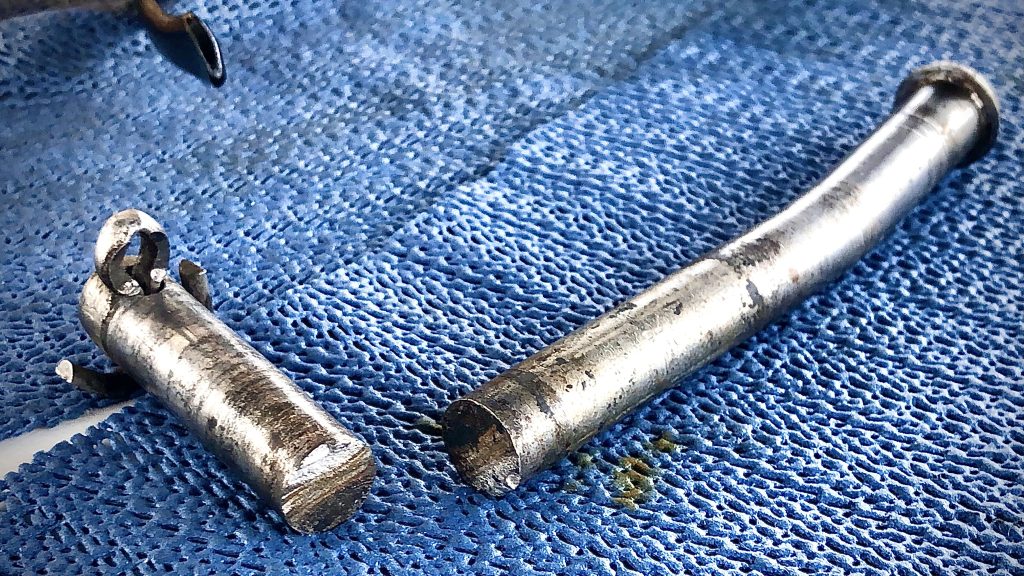
How lucky that it chose a time when we were drifting with 4 knots of apparent wind and we were there to witness it. As it was getting dark, we just hacked together a temporary fix to secure the boom to the gooseneck and stop it from moving. Our challenge for the next day was to devise a repair that would last 3,543 miles to Nuka Hiva…

After a slow night, close reaching on the headsail only, we got to work first thing to repair the gooseneck. Crawling along at 4 knots under headsail only when we were faced with at least 4 days of windward sailing was just not an option.

While on night watch I scoured my memory banks trying to remember whether I had something, stowed somewhere, that could be used to replace the broken pin. I had a mental picture of a stainless-steel pin of about the same diameter (1/2 inch) but could not place where it had come from or what it was used for. I eventually decided that, if it in fact existed, it was probably in the box of running rigging fittings in the starboard lazarette. Joy of joys when, on checking this morning, I found a pin, 1/2 in diameter and about 6 inches long in that exact spot. It has a 90-degree bend in one end and holes drilled to take split rings. I recalled that it used to secure the old anchor to the old bow roller when I bought Sunny Spells. It was about 1/2 in too long, but otherwise a perfect fit, with a stack of washers scavenged from other places used to fill the excess length.
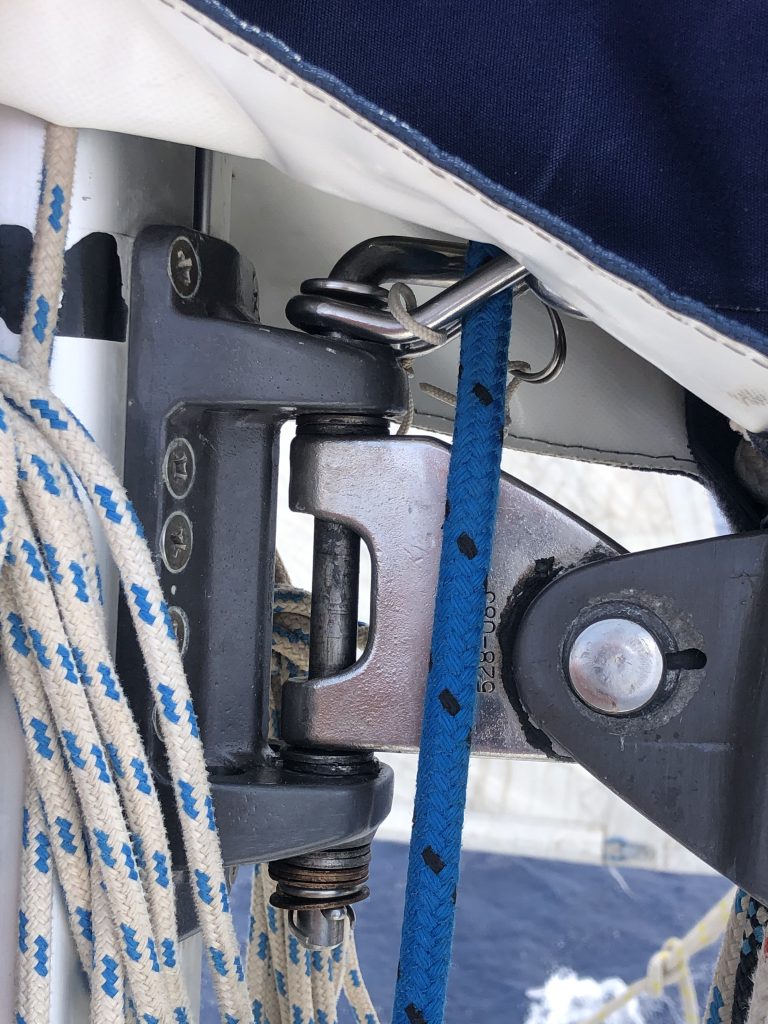
Once the replacement pin was fitted we hoisted the main and within half an hour it was blowing 18 knots and we were flying along! Both crew members were pretty relieved!
Breaking Free from the Gulf of Panama

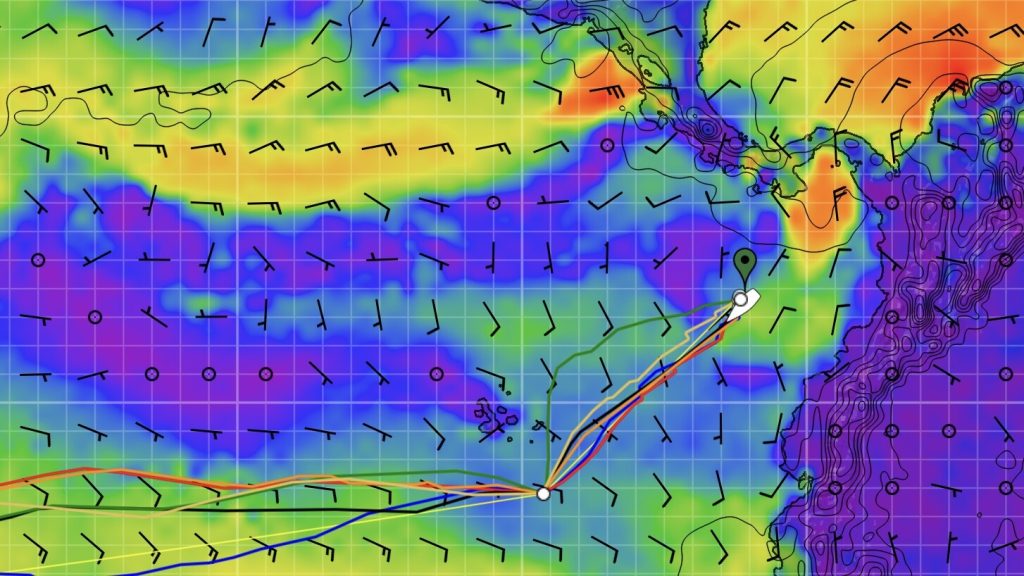
We did not have any time to contemplate the upcoming 4-week passage across the Pacific from Panama to French Polynesia. We had a downwind forecast for the Gulf of Panama and we had to leave. As soon as we were cleared out, we made for Taboga Island where we would spend our last night before leaving for the Marquesas.

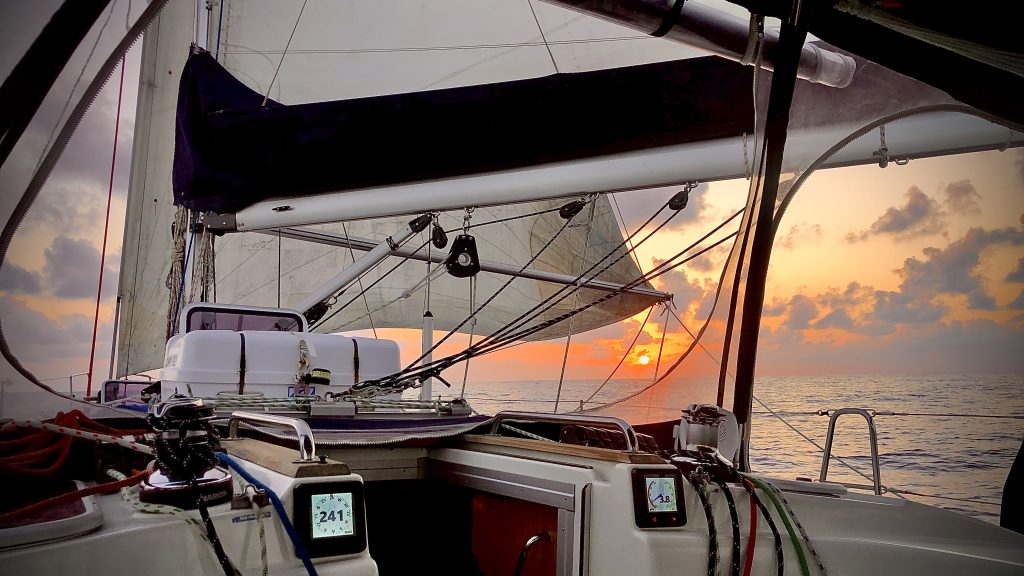
We got up just before 6PM and, after a coffee, rigged the two poles ready for our goosewing setup. Just before 7AM we weighed anchor and motored out of the Taboga anchorage. The wind was light but soon picked up to around 12 knots on the starboard quarter, allowing us to glide along at 6 to 7 knots on a calm sea, with 4,000 miles to go to the Marquesas.

The wind veered a bit more west and we were on a dead run directly for our next waypoint. Six or seven other boats all left various anchorages and marinas around Panamá City at the same time, not that it’s a race or anything.

With sunny weather we were able to make water, run the StarLink and bring our batteries to 100% by 2PM. We were running the fridge and freezer flat out to bank some energy for the night.

As forecast, the wind picked up around 6PM and was soon blowing around 20 knots from the north. Sunny Spells accelerated and we were soon hitting 10 knots plus over the ground, helped along by 2 knots of current. We’ve averaged almost exactly 10 knots during the night. The sea state took a turn for the worse, of course, but it was still pretty benign, compared to what we had in the Atlantic or the Caribbean Sea.

By the morning of the 14th we were south of the Las Perlas Islands, sailing in company with a few boobies and a curious dolphin. Winds remained workable, and by mid-morning we were close reaching at 5 to 6 knots, enjoying the last of the coastal current before it turned against us. With no need to trim and just the two of us aboard, watches flowed into meals, naps, and stargazing shifts under a gentle, cloudless sky.

We rounded Punta Mala in the early hours of the 15th. True to its name, it offered a short punch of uncomfortable chop and some inconsistent breeze, but nothing that warranted complaint. We had expected worse. Once around the point, the wind backed slightly and we bore away, finally turning west and leaving the Gulf of Panama behind us.

The air feels different now. Lighter. The next waypoint is south-east of Galápagos where we expect to turn west and pick up the trades

Slow Dance to Portobelo

After 11 weeks in Le Marin waiting, the anchor finally came up and Sunny Spells once again pointed her bow west — bound for Portobelo, Panama, with 1,268 miles of Caribbean Sea ahead and a generous weather window on offer.

Departure day was textbook. Moderate 10 to 18 knot tradewinds from behind and a comfortable sea made for a spirited start. It was just Maria and me this time, running our tried-and-tested 6-hour shifts from the Indian Ocean crossing. The waxing moon offered a silver trail westward, and Starlink meant we could share our sunset in real-time. Not bad, this 21st-century sailing.

From the outset, conditions were dreamy: consistent wind, a favourable Equatorial Current giving us up to 2 knots over the ground, and day after day of fast, comfortable sailing. For nearly 900 miles, we didn’t so much as touch a sail. It was one of those rare passages where the log fills itself and the only thing left to do is eat, nap, adjust the firmware, and debate whether we’re going too fast to bother fishing.

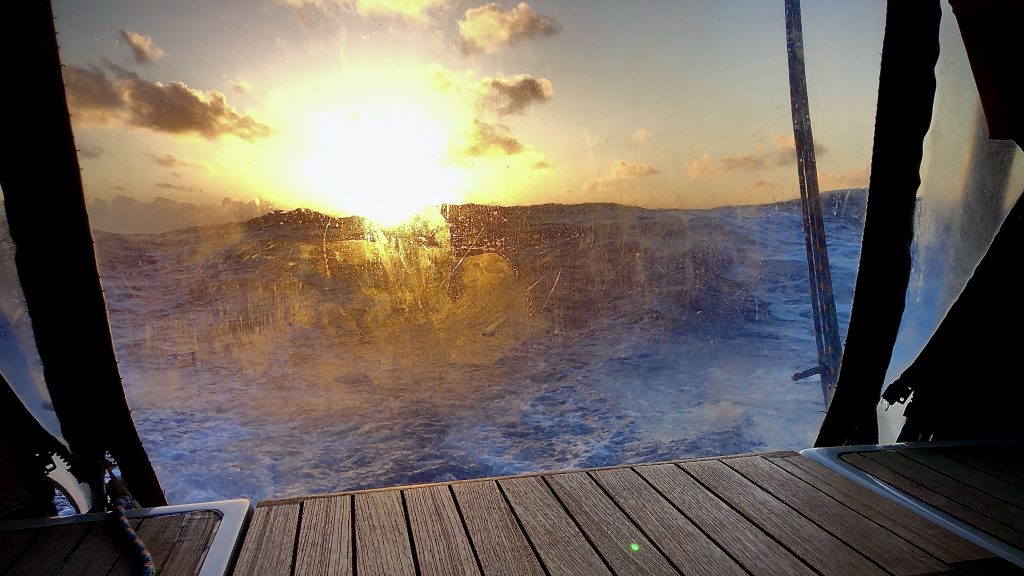
We passed the ABC islands — Bonaire, Curaçao, Aruba — by night, crossing the halfway point near Curaçao. A brief spell of stronger winds brought lively conditions, with short, steep seas slapping over the transom and the odd ankle-deep reminder that the Caribbean can get punchy when it wants to. But it didn’t last.

By Day 6 the wind began to slacken. Slowly at first — just enough to make us fiddle with sails and debate genoa swaps — and then, by Day 7, to the point where the main sail flopped helplessly in the swell and had to be bagged. We drifted with the staysail poled out and made the best of a gentle ride under a full moon. Even in 1.4 knots of apparent wind, we made 50 miles overnight. We called it a win.

Eventually, the engine was summoned to balance the batteries and encourage our progress. A tangled lump of Sargassum offered some brief drama on the prop, but reverse cleared it. Three hours later we were back under sail — exactly the same sail plan as before, as if nothing had happened.

With light winds and flat seas, Sunny Spells entered her element: beam reaching in 6–8 knots, perfectly balanced, sliding along at 5–6 knots like a content cat. The only job left was to switch out sails — the poled-out downwind rig was retired after a heroic run, and we bent on the big #2 genoa and full main for the final reach into Panama.

The last 24 hours were perhaps the most idyllic of the lot: blue skies, glassy sea, and enough breeze to keep us moving without disturbing the peace. We crossed the last hundred miles slowly, enjoying the ride. Then, just to keep us sharp, the final approach stiffened up with gusts to 18 knots and a brisk reach across the busy approach lanes to the Panama Canal.

Anchoring in the dark in an unfamiliar bay — full of unlit obstructions, naturally — was a fitting finale. But we dropped hook safely in the still waters of Portobelo and cracked open our long-overdue anchor beers. The slow dance is over. We’ve made it across another sea.

Two Thousand Miles and One Last Breeze

The last leg of our Atlantic crossing played out like a slow dance — one led alternately by the wind and the hum of the diesel engine.

Boxing Day brought a pause in the wind and a shift in tempo. Around 3AM the breeze dropped below five knots, and with sails flogging uselessly, we fired up the motor. Mercifully, the seas were now long and lazy — perfect motoring weather, if there is such a thing. With electricity on tap, it turned into a productive day: Sunny Spells got a washdown to rid herself of Saharan dust, the laundry buckets were put to work, and the galley became a bakery. Gabro produced a sourdough loaf, I baked my mother’s buttermilk rusks, and Mariona conjured up a tuna stew. We even managed a hull scrub and a sail change.

Later in the day the breeze began to fill in. With the big laminate genoa and mainsail up, we found ourselves reaching comfortably, finally pointed toward Martinique.

Forecast models were now diverging, but we chose to believe the optimistic one — and for a while, it paid off. The next few days were a medley of light-air sailing punctuated by glassy, oil-slick motoring. One morning, the wind teased us with just enough puff to fly full canvas. A baby Mahi Mahi came and went (lucky fish), followed shortly by an unlucky 7kg yellowfin tuna who made a final and delicious contribution to the voyage.

December 29th was a slow day under power, and morale dipped with the droning engine. Still, we found pleasure in the little things: Mariona baked banana bread and wholewheat loaf, and dinner was pasta with cream and veg. At sunset, we flirted with sailing again — the wind briefly stirred, then stilled. As we doused the mainsail in frustration, a solid 15-knot NE breeze kicked in just to mock us. We hoisted again, reefed, unreefed, debated reefing again. It was a full evening of trimming and trimming again, ending with Mariona hand-steering in whispers of wind to keep us above 4 knots. Remarkably, we still clocked 126 miles for the day.

By the 30th, Barbados was abeam and we could smell landfall. Despite a forecast for motoring, we managed to sail the whole day on a close reach in 8–12 knots, clocking a satisfying 77 miles for the daylight hours. A plane passed overhead — the first one we’d seen since leaving Las Palmas — and lights twinkled on the horizon. But the AIS remained eerily silent. Despite the flood of pink icons on MarineTraffic, the ocean out here still feels vast and lonely.

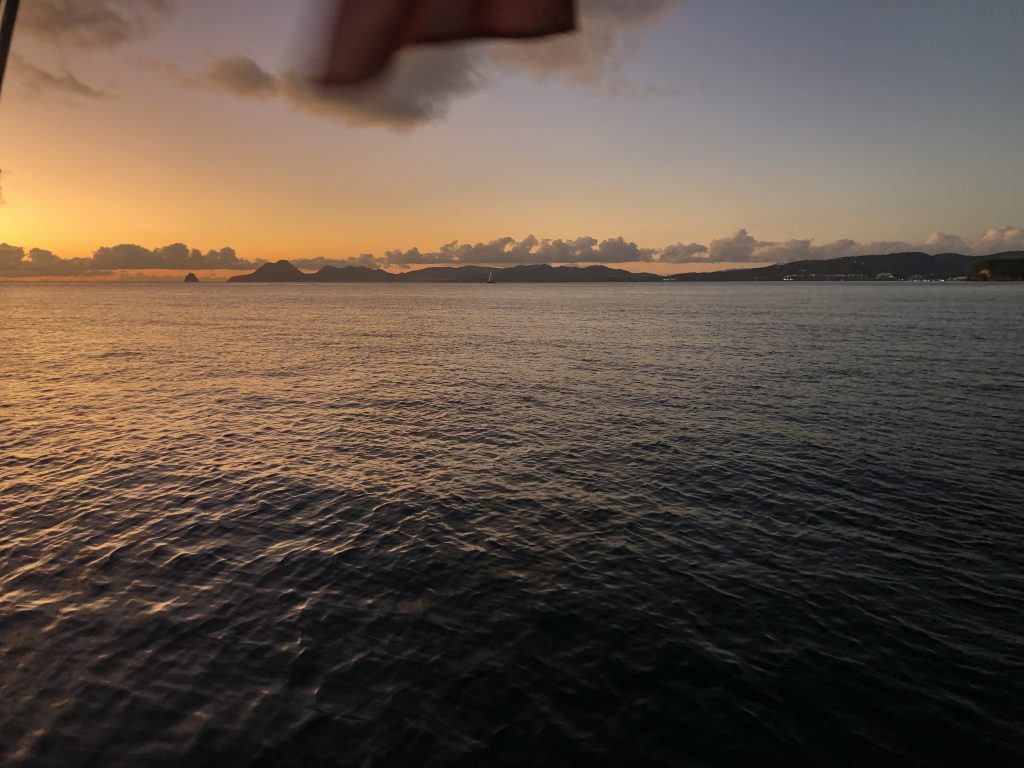
We closed the gap on Martinique in style. A final spinnaker run saw us gliding along at full speed under canvas on New Year’s Eve, land rising gently on the horizon. First Saint Lucia’s mountains, then the low coast of Martinique. At 3:30PM local time, we let go the anchor at Petit Anse de Salines, after 2,250 miles and 17 days at sea since Mindelo.

That night, there were hammocks, a long-overdue drink, and the promise of pizza. There may even have been fireworks — but we didn’t make it past dinner.

Martinique Landfall
Martinique Landfall