Liverpool River to Mullet Bay, North Goulburn Island

A long day for us as we’ve gotten used to 35 mile days, getting to the next anchorage by lunchtime. We had to get out of Liverpool River (about 9 miles) , sail the 45 odd miles to the Goulburn Islands and then give the south-west corner of North Goulburn Island a wide berth to clear the reef extending SE.

Tides were a factor: we had to leave just on high tide (around 8am) and get to the Goulburn Islands just after the afternoonhigh tide (6pm) or face a stiff tidal rip going the other way as we passed between South and North Goulburn Islands. It was also full moon the previous night, so a spring tide made tidal effects even more significant.
Goulburn Islands, Arnhem Land
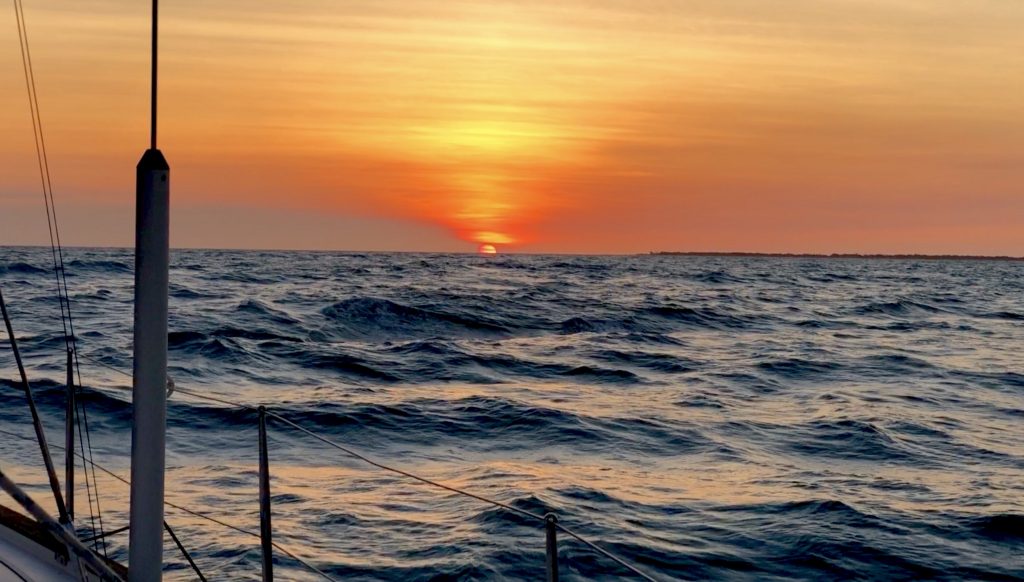
Between the Goulburn Islands, a smoky sunset

With the wind dead astern and a rolly sea, sailing was a mixed bag and we motored a fair bit, making water when the ocean was not too milky. A nice size Trevally caught on the troll had us feeling a bit guilty when it started loudly croaking while I performed the last rites with a knife. We soon got over it and it was cleaned and marinaded for the evening’s stir fry, which turned out to be a huge success (Teriyaki, rice wine vinegar, sesame oil, chilli, garlic and spring onion went into the marinade).
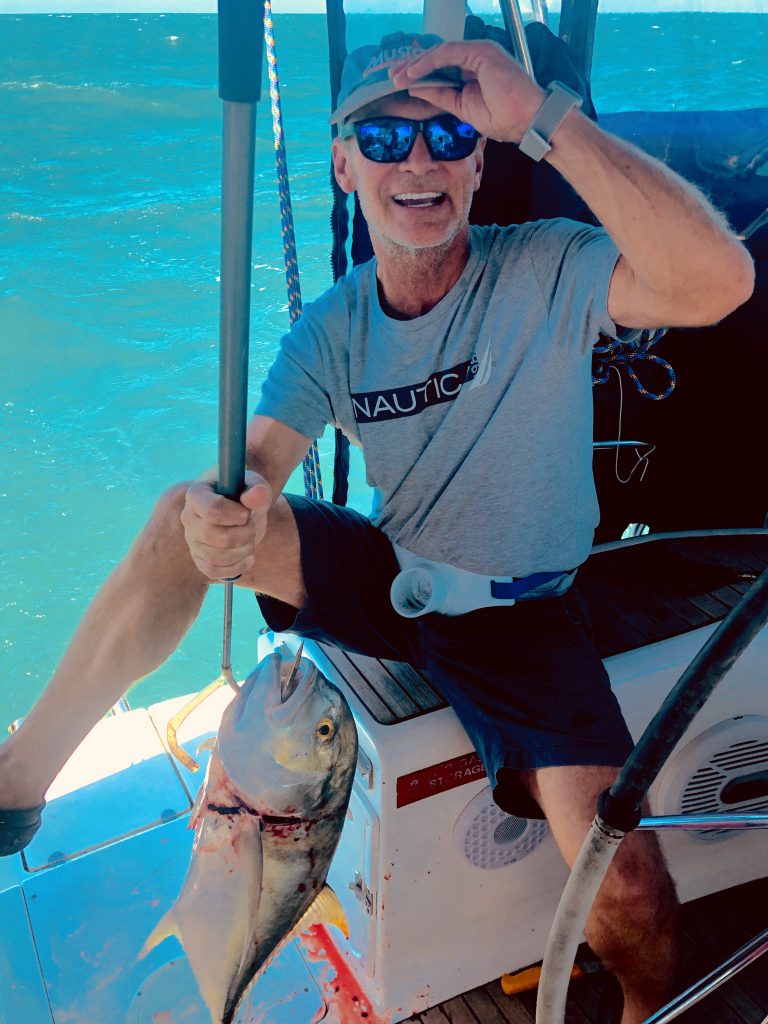
(Not so) Giant Trevally

Yotties info: currents through most of the narrow channels in Arnhem Land “ebb west/flood east”. The channel between the Goulburn Islands is meant to be the same, but it continued to set east (against our course and into the wind) for at least an hour after high tide. This was on a full moon spring tide, so our experience may not hold for other times.

Mullet Bay is tricky to get into. There’s reefs and rocks to contend with and, disconcertingly, the bottom is reef/rock with deep (2m) cracks and crevices visible on the sounder. This holds until the bottom shoals to about 5 metres, where it becomes a smooth sandy bottom. We motored up and down parallel to the beach for a while before we got close/shallow enough to find good anchoring. Once there, however, the anchor set securely on the first attempt. The anchor and chain also came up spotlessly clean the next morning, free from the toffee-consistency grey clay we had dragged up in Liverpool River. A coarse clean sand is assumed to be on the bottom.

Mullet Bay Anchorage (map courtesy Navionics)

A new adventure

The day has finally dawned for departure on our new adventure. We’ve set aside a minimum of six months to go cruising and see how we like the lifestyle. We were anchored overnight in Morning Bay, Pittwater (Sydney) and set the alarm for 5:30AM, planning to be underway by first light and have sails up by sunrise. It was clear and cold (April weather) and we procrastinated a bit, but by 6:15AM Maria had weighed anchor and we were sailing up Pittwater towards Barrenjoey Head.

Our target for today – a safe, easy sail/motor to Broughton Island, east of Nelson Bay.

Sailing up Pittwater

Windhoek to Gobabis and Bospoort Farm

From the veldt – green beyond for miles stretching out ahead of us. Springbok and huge beef ranches.
Apparently tomorrow the countryside will be so impressive that the last few weeks will pale into insignificance – so I’d best remind myself of the tremendous time we’ve had since leaving Windhoek a couple of weeks ago (almost):
– geology and veldt that changed with each escarpment or cutting through rock as we made our way along roads;
– roads that went from sealed tar roads to wet sand, to gravel where the grass grows from the edges in towards the middle, with the spoor of various wildlife having left their mark. And then as we headed from near the Botswana border back to the west coast we drove across desert – with no one else – and then on to the (somewhat bizarre) salt roads from north of Henties Bay to Swakopmund.
We spent almost a week on Bospoort farm (between Gobabis and Summerdown) where the giraffes came daily to feed in the (350 hectare) ‘paddock’ next to the homestead; where Manie presented the boys with their own handmade catapults, where the boys learnt to shoot rifles and where they fell in love with the working sheep dogs Max and Moritz. Oscar rose early each morning ( long before anyone else) desperate to be out there ‘doing farming’; driving out with his Uncle Fanie to check fences and water troughs and then helping Julius and Manie fix broken fences. He was in his element and at his happiest – busy and with animals, who don’t judge him but accept him for his quirky ways and most of all for his generous love and kindness. We listened to jackals at night and ‘go-way’ birds during the day; had Easter egg hunts and did obligatory egg decorating/painting; we rode quad bikes and travelled in the back of the ‘bakkie’, we ducked from camel thorn trees and hunted for dung beetles – and then we left and headed on more amazing roads across country and made our way to Erindi Game Reserve: the most impressive campsite ever! From there we saw game, African Wild Dogs, elephant and hippos and searched for lions (I found lion when in desperation I went on a game drive one afternoon). And then by chance we headed to the San Village for a tour one morning – fascinated with this nomadic tribes way of life. By chance the big storm came later that morning as we drank coffee at the Lodge and watched hippo and crocodile move through the water and respond to the massive electric storm overhead – and then by chance we were entertained by three elephants who arrived at the watering hole – an experience for us all. The elephants knocked crocodiles out of the way and into the water. Then the elephants pushed each other into the water and continued in some ritual which was either playful or in order to decide the pecking order – we were never sure which.
The rain poured that night, with lightning everywhere around us – so much so we pulled the boys out of their damp tent and popped them in the back of the land cruiser to sleep – which really pleased them – another ‘first’ on the list of experiences. Gerhard and Fanie attempted to keep the braai burning so that we could cook the meat for dinner (fuelled by alcohol to keep warm); we ate dinner perched on chairs in the shower and toilet (with plenty of wine!).
From Erindi we headed into the desert and onto Swakopmund – which despite clearly being a significant town (second largest in Namibia) I found it rather odd. There’s a constant cloud/mist that hangs over Swakopmund. It’s on the edge of the desert with the most fabulous dunes (including the infamous Dune 7 – well done Hugo for scrambling up that hot one bright sunny morning).
Swakopmund was very German (as per colonisation) and so many of the houses have a very German look and there are some fabulous restaurants serving humongous size portions of delicious food (put off the diet for another week then…and let the belt out another hole!). But it all looks a bit dishevelled and in need of some tlc. I was assured that it shines during the summer months when it ‘buzzes’ during the holiday season …it is Namibia’s only coastal resort….but I still felt a bit intrigued by the place.

Over the border to Namibia

I’m getting a bit boring with marvelling at the beauty of South Africa – so I’ll bore you with Namibia instead. We left early from Langebaan as the sun rose over Table Mountain – way off in the distance. We were heading north for the Namibian border, over the Orange River. We saw little traffic all day – other than when going through enormous stretches of road works (cutely referred to as ‘stop – goes’). Luck was on our side and the really early start paid off, as we were hardly delayed at all by them – and don’t think we slowed our speed because of the road works …doesn’t seem to work like that round here.

We drove over mountain passes and straight roads that stretch beyond for miles (we only talked about Australian roads being long, straight and empty when I grew up – no one ever referred to the South African ones: clearly an oversight). We saw ostriches and flamingoes, dassies (like guinea pigs) and meerkats, wild goats and sheep. I have no idea what the latter were eating – it was wild rocky desert. I reckoned they must calculate their stock levels on how many acres per head, rather than the normal ‘how many head of stock per acre’. I don’t think farming out on these never ending wild and barren mountains is an easy life.. And then saw a combine harvester! What on earth was that doing parked up here? We did see ‘paddocks’ with large rocks and something that looked a bit like stubble in them – but I’ve no idea what on earth it was (need to ask my brother in law).

And finally we drove down into the valley of the Orange River and out of South Africa, green and fertile, grape vines and fruit trees. The heat hit us as we joined the queue in a cramped and airless room waiting for our papers and passports to be approved by the Namibian officials, and then another queue for the foreign car papers, and finally the queue to get through the border post. Thankfully we weren’t subjected to the car being emptied and checked over – unlike some of the cars ahead of us. Hugo was most concerned: we’d warned him that if he was cheeky and impolite to any of the border officials they might pull the stuffing out of his beloved teddy to check for drugs. He was aghast – and behaved impeccably!

And on we drove through hot dusty desert to Felix United. Gorgeous staff, thatched cabanas to stay in, chilled wine and cool beers overlooking the river whilst the sun set behind the mountains, a warm wind blew and the boys played (noisily!) in the pool. Bliss!